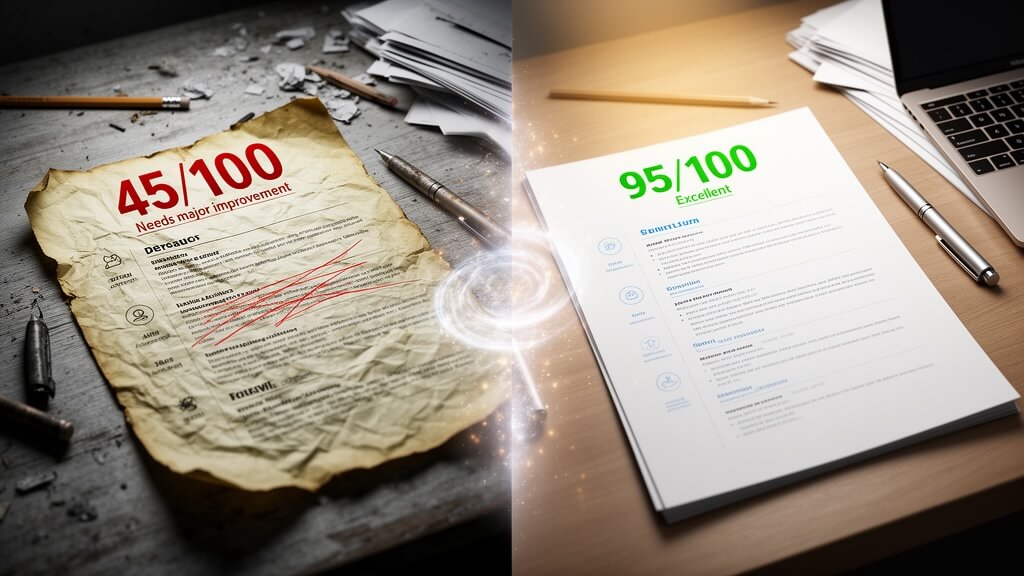
Your resume score is a single number that estimates how well your resume is likely to perform once it hits an applicant tracking system and a recruiter’s screen. It rolls up formatting, keyword match, achievement strength, focus, and proof into one figure you can track as you edit.
This guide explains what the number actually measures, what counts as a good resume score, how scoring is calculated, and the fastest ways to raise yours. If you just want a baseline right now, run a free AI resume score and come back to interpret the result.
What is a resume score?
A resume score is a diagnostic snapshot. Instead of guessing whether your resume is “good,” it translates several separate quality signals into one comparable number, usually on a 0-100 scale.
The point is not the number itself. The point is that a score lets you:
- Compare two versions of the same resume objectively.
- See which category is dragging you down before you rewrite anything.
- Measure whether an edit actually helped or just changed wording.
Think of it like a credit score for your job search: it does not get you the job, but a low one quietly blocks you before a human ever weighs in.
What is a good resume score?
For most job seekers on a 0-100 scale, here is how the bands break down:
| Score band | What it means | What to do next |
|---|---|---|
| 90-100 | Interview-ready. Strong across formatting, keywords, and impact. | Targeted polish only. |
| 80-89 | Strong baseline with a few clear optimization opportunities. | Fix the 1-2 weakest categories. |
| 70-79 | Competitive in some roles, filtered in others. | Add keywords and quantify bullets. |
| 60-69 | Readable but under-optimized for ATS and relevance. | Rework formatting and top bullets. |
| Below 60 | Core issues likely block you before a recruiter reads it. | Rebuild structure before applying. |
Aim for 80+ before a normal application and 85+ for competitive or senior roles. The higher the competition, the more your metrics and role-specific keywords need to carry the score.
How is a resume score calculated?
Scoring tools vary, but almost all of them weight the same five factors. Here is a transparent version of the rubric so you can estimate your own score by hand:
| Factor | What it measures | Weight |
|---|---|---|
| ATS formatting and parsing | Single-column layout, standard headings, consistent dates, machine-readable PDF | 25 |
| Keyword and role match | Core skills, tools, and terms from the target job appear naturally | 25 |
| Achievement strength | Bullets show action, scope, and quantified outcomes | 25 |
| Relevance and focus | Content is tailored to one role path with minimal filler | 15 |
| Credibility and proof | Metrics, certifications, tools, and context back up major claims | 10 |
Add each category’s earned points to get a score out of 100. If you want the deeper weighted version, use the free resume grader rubric, and for the technical side, the ATS score guide explains parsing in detail.
Why your resume score matters more than it looks
A weak score is rarely about talent. It usually means one of three invisible things is happening:
- The ATS cannot read your resume cleanly, so your experience never gets indexed correctly.
- Your keywords do not match the job, so you rank below other candidates in recruiter searches.
- Your bullets describe duties, not results, so even a human skim does not register your impact.
Each of these filters you out silently. A resume score makes the invisible visible, which is why checking it before you apply is one of the highest-leverage things you can do in a job search.
How to raise your resume score fast
You can move most scores meaningfully in a single editing session. Work in this order, because early fixes unlock the later ones:
- Get a baseline. Run a free AI resume score so you know your starting number and weakest category.
- Fix ATS formatting first. Switch to a single-column layout, use standard section headings, remove tables, text boxes, and image-only PDFs, and export a text-based PDF.
- Close the keyword gap. Pull the repeated skills, tools, and terms from one target job description and work the ones you can honestly support into your summary, skills, and bullets.
- Rewrite your five weakest bullets. Give each an action, a method, scope, and a measurable outcome.
- Tighten focus. Make sure the top third of the resume clearly points at the role you want now.
- Re-score and compare. Run the check again and confirm the number actually moved.
Weak vs strong bullet
The single biggest score lever is usually bullet quality. Compare:
- Weak: “Responsible for managing social media accounts.”
- Strong: “Grew Instagram engagement 34% in 4 months by launching a weekly content calendar and analyzing post performance to double down on top formats.”
The strong version adds action, method, scope, and a metric, which lifts both the achievement-strength and proof categories at once.
Resume score vs rating vs grade vs check
These terms overlap, but people search for slightly different things:
| Term | What it emphasizes | Best for |
|---|---|---|
| Resume score | A single number rolling up all quality signals | Tracking progress across edits |
| Resume rating | A fast benchmark snapshot | Quick “where do I stand?” checks |
| Resume grade | A weighted rubric across categories | Deciding what to fix first |
| Resume evaluation | A detailed diagnosis with feedback | Understanding why the score is low |
The strongest workflow uses all four: score for a baseline, rate to benchmark, grade to prioritize, and evaluate to understand the reasons.
FAQ
What is a good resume score?
On a 0-100 scale, 80 and above is a strong, interview-ready score for most roles. 70-79 is competitive but improvable, 60-69 usually needs work before high-volume applications, and below 60 signals core issues in formatting, keywords, or impact.
How is a resume score calculated?
Most tools combine five weighted factors: ATS formatting and parse reliability, keyword and role match, bullet strength and measurability, focus and relevance, and proof density. Each contributes points toward a single score out of 100.
Is a free resume score accurate?
It is accurate as a diagnostic, not a prediction. A free score reliably flags structural, keyword, and impact gaps you can fix, but interview outcomes still depend on role fit, competition, and application strategy.
How can I raise my resume score quickly?
Fix ATS formatting first, add the missing keywords from your target job, then rewrite your weakest bullets with an action, a metric, and an outcome. Those three moves raise most scores in one session.
Does a higher resume score mean more interviews?
A higher score removes the technical and clarity barriers that filter most applicants out, which improves your odds. It is not a guarantee, but it is a prerequisite for getting seen.
Ready to see your number? Run the free AI resume score checker, then use the rubric above to raise it before your next application.